
Project Name
Shennong Agriculture Intelligent Agent
Project Goal
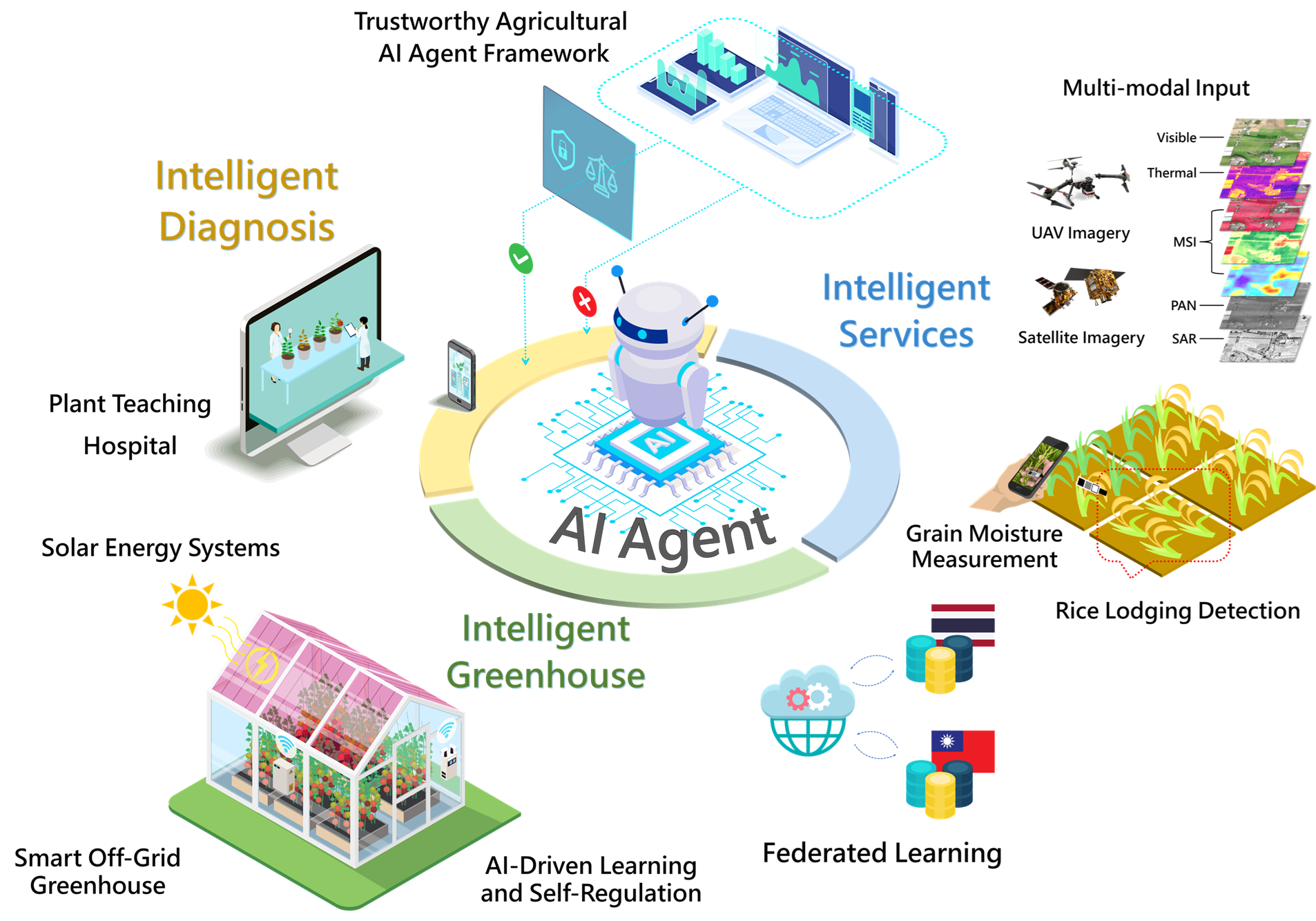
This project centers on the development of Shennong Intelligent Agent for Smart Agriculture, aiming to advance the system-level integration and real-world deployment of AI agent technologies in agriculture. The goal is to build a next-generation smart agriculture system with autonomous reasoning, cross-domain collaboration, and explainable decision-making capabilities. The project integrates four key components: lightweight agricultural AI agent core technologies, a trustworthy AI governance framework, federated learning–based smart agricultural services, and an energy-autonomous off-grid intelligent greenhouse platform. These technologies collectively address critical challenges in agriculture, including data silos, fragmented decision processes, labor shortages, and sustainability constraints. By enhancing the efficiency of agricultural diagnosis, improving the timeliness of disaster assessment, and enabling low-carbon, energy-independent facility agriculture, the project seeks to promote agricultural digital transformation and establish a scalable, internationally competitive AI-driven smart agriculture model.
Project Description
In response to climate change, labor shortages, and the demand for agricultural digital transformation, this project develops an integrated AI agent–based smart agriculture system known as the Shennong Intelligent Agent. The project advances agriculture from isolated AI tool applications toward an autonomous, collaborative, and intelligent decision-making system. The research integrates three major application dimensions: AI core technologies, smart agricultural services, and intelligent greenhouses. Technically, the project develops lightweight agricultural AI agents using agent coaching and heterogeneous multi-agent collaboration, enabling cost-effective and efficient deployment. A trustworthy AI governance framework is also established to ensure system transparency, security, and explainability in alignment with international standards. On the application side, federated learning is employed to integrate agricultural data from multiple regions and countries, allowing collaborative disaster assessment and crop monitoring without sharing raw data. In parallel, an off-grid, AI-driven intelligent greenhouse platform is developed by integrating semi-transparent solar energy systems with adaptive environmental control, enabling energy autonomy and precise cultivation management. Overall, the project aims to enhance agricultural efficiency, resilience, and sustainability, while strengthening Taiwan’s technological leadership and global competitiveness in AI-driven smart agriculture.