
Project Name
A Secure and Privacy-Enhanced Domestic Smart Healthcare Platform: Advancing Innovative Elderly Care Through Cross-Reality and AI Integration
Project Goal
This project centers on a Smart Healthcare Digital Twin Platform, integrating Cross Reality (XR), Artificial Intelligence (AI), and the Internet of Medical Things (IoMT) to build an intelligent care solution applicable to home-based, institutional, and remote care settings. By leveraging the QOCA® APC platform to connect wearable and non-wearable sensing devices, and combining edge computing with cloud-based AI inference, the project aims to deliver a highly integrated, privacy-preserving, and highly personalized health management system. The system seeks to achieve objectives including multimodal physiological signal integration and modeling, intelligent design of wearable and non-wearable devices, personalized and proactive health monitoring mechanisms, enhanced cybersecurity and privacy protection, as well as clinical validation and promotion of industrial translation.
Project Description
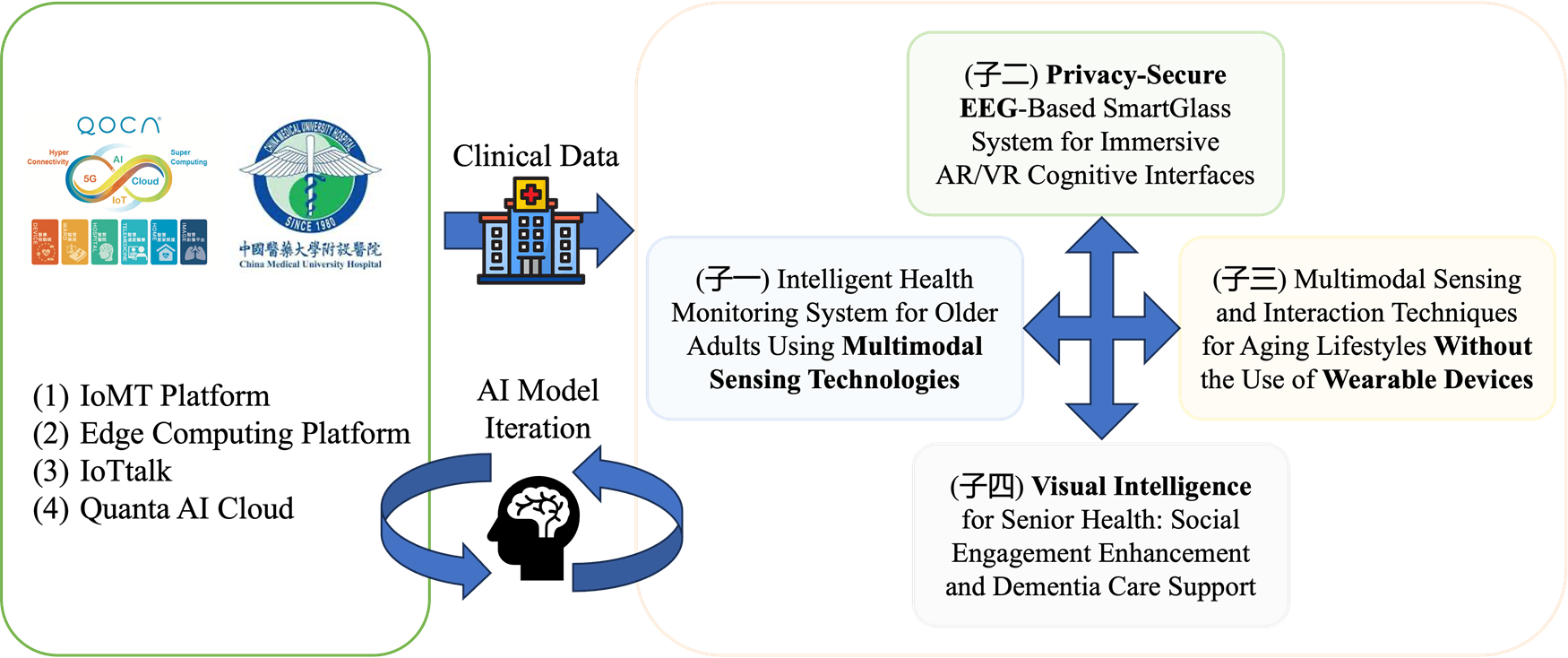
In response to Taiwan’s aging population, this project proposes an innovative Smart Medical Digital Twin Platform integrating XR and AI. Built on Quanta’s QOCA®APC medical cloud, the system emphasizes high privacy, security, and personalization for telemedicine, home care, and long-term healthcare. The project comprises one central coordination project and four technical sub-projects: Main Project: Focuses on the integration and operation of the QOCA platform. It oversees secure data transmission, privacy protection, and clinical validation, ensuring seamless resource coordination and system deployment across all sub-projects. Sub-project 1: Develops a multimodal health monitoring system utilizing wearable sensors (PPG, ECG, EEG, sEMG). It trains a Multimodal Bio-signal Large Language Model (MB-LLM) and incorporates signal/model optimization and privacy mechanisms to enhance monitoring accuracy and efficiency. Sub-project 2: Creates SmartGlass devices integrating Brain-Computer Interface (BCI) and AR for immersive rehabilitation. It introduces BrainPrint (EEG-based biometrics) and a personalized rehab recommendation system with real-time multimodal feedback. Sub-project 3: Establishes a non-wearable observation system combining millimeter-wave radar and thermal imaging. It enables non-contact physiological monitoring and behavior recognition, using LLMs to generate structured health logs and real-time anomaly alerts. Sub-project 4: Utilizes Vision AI and Generative AI for a privacy-friendly dementia care platform. Technologies include posture detection, cross-domain activity tracking, and semantic alignment to promote elderly mental health and social engagement. These sub-projects are highly complementary, sharing data and models via the QOCA platform. Together, they form a deployable and trustworthy AI-assisted care ecosystem, enhancing Taiwan’s smart healthcare competitiveness and offering significant potential for international expansion within global Chinese communities.