
Project Name
An Interactive Language Learning AI Platform for the Taiwanese Context: Multimodal Technology Development with a Focus on Educational Applications
Project Goal
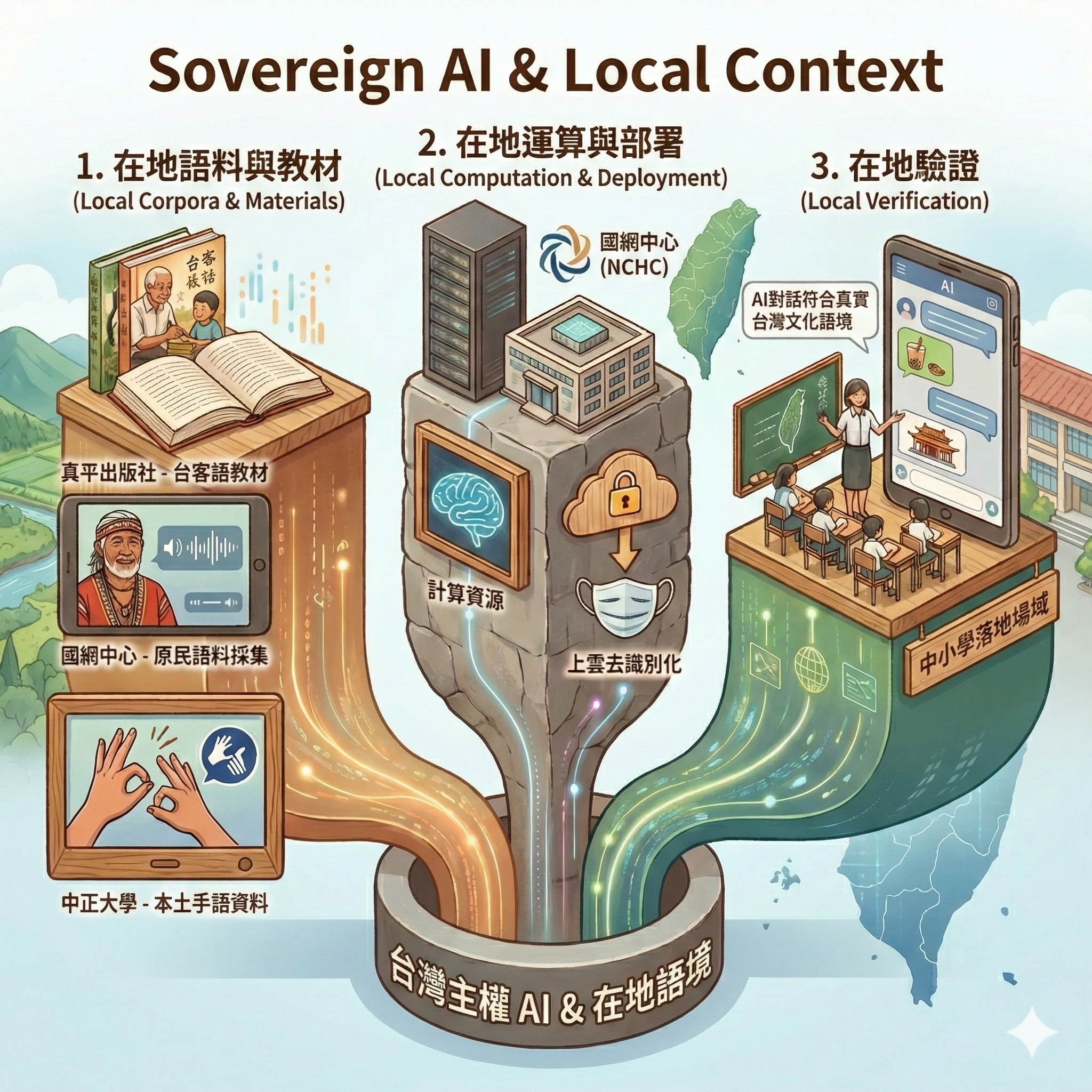
This project aims to build an AI language learning system for Taiwan that possesses "sovereignty," "multilingual support," "multimodal interaction," and "local context responsiveness." The core objective is to respond to the educational and cultural heritage needs of Taiwan's multilingual society, comprehensively supporting Mandarin, Taiwanese, Hakka, indigenous languages (such as Truku and Tsou), English, and Taiwanese Sign Language. Through the integration of five sub-project technologies—speech understanding, generative AI architecture, linguistic validation, multimodal retrieval-augmented generation (RAG), and dynamic assessment driven by Item Response Theory (IRT)—this project is committed to creating a practically implementable interactive teaching platform. In addition to providing AI learning companions and digital teaching material generation services, it also aims to implement language equality, promote cultural sustainability, and strengthen Taiwan's international competitiveness in digital sovereignty and AI language technology through local deployment and interpretable design.
Project Description
This project centers on an "Interactive Language Learning AI Platform in the Taiwanese Context." Addressing Taiwan's urgent needs in language education, cultural preservation, and digital sovereignty, it integrates innovative cross-disciplinary technologies to develop a localized, reliable, and sovereign AI system. The project covers Mandarin, Taiwanese, Hakka, English, indigenous languages, and Taiwanese Sign Language, aiming to bridge the digital gap in language learning and establish a learning environment aligned with local cultural contexts. In terms of technical development architecture, this project is closely linked by five main research axes: 1. Next-Generation Speech Technology: Developing models based on emerging architectures to optimize multilingual speech understanding and generation. 2. Interactive System Innovation: Developing AI learning companions, voice guidance, and synchronized audio-visual generation functions to strengthen learning feedback mechanisms. 3. Linguistic Validation: Establishing a thick-data corpus and a subjectivity evaluation system to ensure the accuracy of cultural interpretation in sign language and multimodal models. 4. Retrieval-Augmented Generation: Utilizing RAG technology to integrate heterogeneous data to endow AI teaching assistants with chain-of-thought reasoning and knowledge augmentation capabilities. 5. Sustainable Operating Framework: Combining Item Response Theory (IRT), a precise dynamic assessment mechanism is established, supporting applications in rural areas and among disadvantaged groups. This project not only pursues technological breakthroughs but also emphasizes practical implementation in the educational setting. Through AI virtual avatars and automatic generation of digital teaching materials, it assists in transforming language teaching models and improving learning outcomes. Ultimately, it aims to establish a demonstrative "Low-resource Languages × Education × Sovereign AI" ecosystem, cultivating multilingual talent in Taiwan and establishing Taiwan's digital sovereignty within the global AI development wave.