
Project Name
Crisis-Aware Medical AI: From Foundational Intelligence to Lightweight Deployment
Project Goal
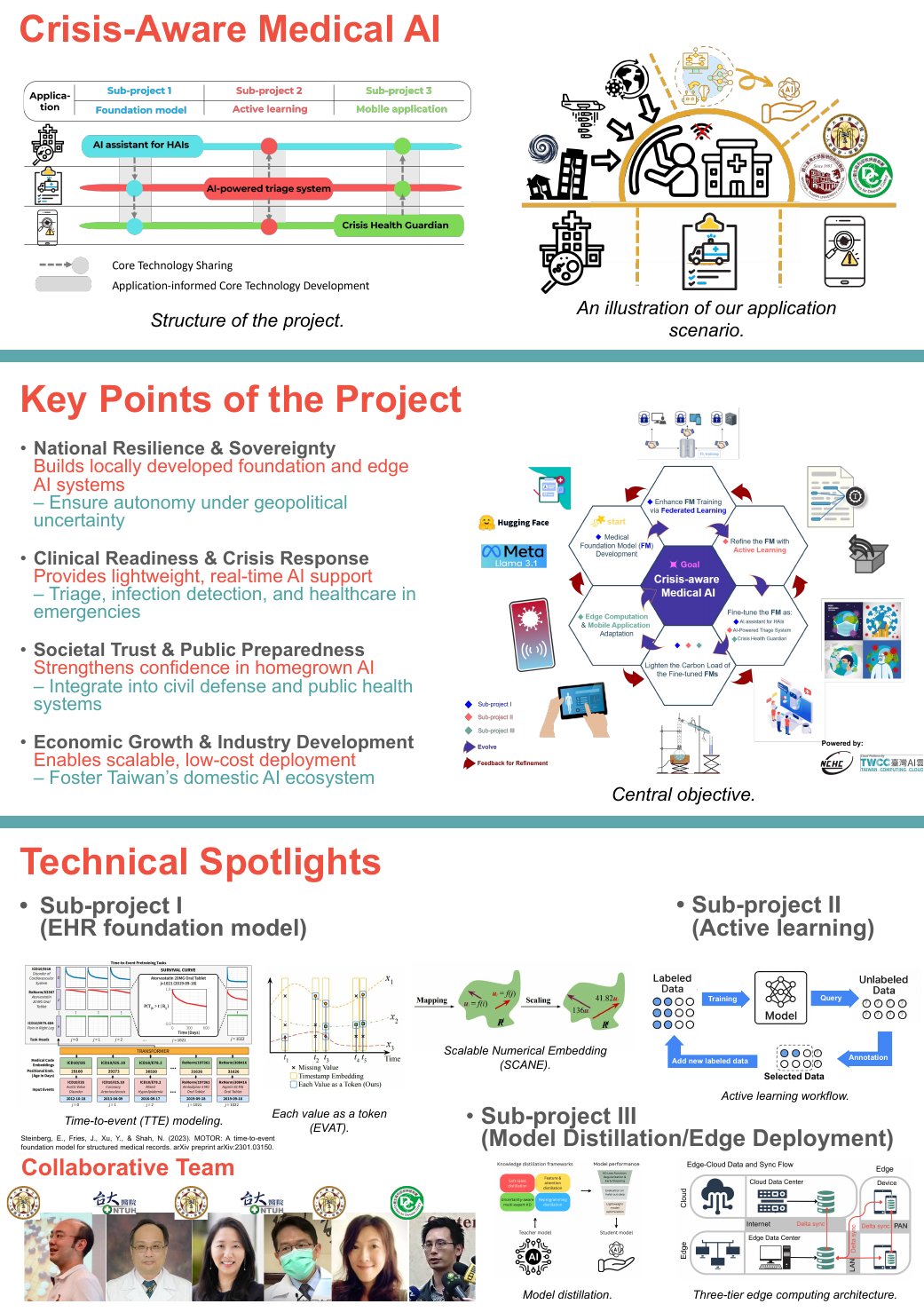
Taiwan faces a convergence of public health challenges, natural disasters, and growing geopolitical threats that demand rapid, resilient, and sovereign technological solutions. This project aims to develop an integrated framework for Crisis-aware Medical AI that is privacy-preserving, energy-efficient, and deployment-ready. Through three tightly coordinated sub-projects, we will deliver end-to-end innovations that serve both national priorities and frontline clinical needs. - Sub-project I builds a medical foundation model using federated learning across multiple healthcare institutions, preserving data privacy while ensuring broad generalizability. - Sub-project II introduces active learning to improve model adaptability and reduce annotation burdens in dynamic and data-scarce environments. - Sub-project III focuses on model distillation and edge deployment, producing lightweight, real-time AI systems for use in resource-limited settings—such as field hospitals and disaster zones. Together, these technologies support three high-impact applications: healthcareassociated infection detection, AI-assisted triage, and crisis health surveillance. By aligning foundational research with practical deployment, the project ensures that each innovation contributes to a sovereign, sustainable AI infrastructure that can operate under real-world constraints. The project will also engage select stakeholders to support long-term adoption and readiness.
Project Description
In the face of escalating public health risks, natural disasters, and geopolitical tensions, Taiwan urgently needs sovereign, sustainable, and crisis-resilient medical AI. This project brings together three tightly integrated sub-projects to deliver an end-to-end solution that meets this national imperative. Sub-project I develops a privacy-preserving foundation model trained via federated learning across diverse healthcare institutions, ensuring broad generalizability without compromising data sovereignty. Sub-project II enhances adaptability through active learning, enabling rapid updates and efficient annotation in evolving clinical contexts. Sub-project III focuses on real-world deployment by distilling these models into compact, energy-efficient architectures optimized for edge devices--- crucial for operation in resource-constrained or unstable environments. The technologies focusing on sovereign and sustainable AI converge in three mission-critical applications: early infection detection, AI-assisted triage, and population-level crisis monitoring. Through seamless integration, each subproject not only contributes core innovations but also aligns with real-world deployment needs. The result is a scalable, trusted, and strategically sovereign AI framework that strengthens Taiwan’s healthcare resilience. Educational programs, including student-industry collaborations and frontline clinician engagement, will ensure that these innovations translate into long-term national capacity.