
Project Name
Cross-Domain Multimodal AI Technologies and Platforms for Next-Generation Smart Manufacturing Applications
Project Goal
Taiwan is a global manufacturing hub with leading capabilities in semiconductors, printed circuit boards (PCB), precision machinery, and advanced electronic assembly. As the manufacturing sector transitions toward Industry 5.0, the focus is shifting beyond automation and digitalization toward human–machine collaboration, autonomous decision-making, and sustainable development. However, current industrial systems remain constrained by fragmented data silos, heterogeneous data formats, limited AI interpretability, and practical challenges in ESG implementation, which collectively hinder large-scale adoption of intelligent manufacturing technologies. The objective of this integrated project is to advance the development and deployment of cross-domain, multi-modal artificial intelligence technologies and platforms for smart manufacturing. By leveraging cutting-edge methodologies in generative learning, semantic understanding, digital twin simulation, anomaly prediction, and trustworthy decision-making, this project aims to establish a highly integrated and modular AI-driven manufacturing system. The proposed system is designed to seamlessly connect data generation, perception, analysis, interpretation, and governance, enabling intelligent systems that are not only efficient but also transparent, reliable, and human-centered. This project brings together five interrelated sub-projects, each addressing a critical component of the intelligent manufacturing pipeline. Through tight integration across these sub-projects, the proposed platform will support end-to-end industrial intelligence, from synthetic data generation and multi-modal sensing to predictive analytics, explainable AI, and decision governance. The platform is designed to be deployable in real industrial environments and scalable across different manufacturing domains. By focusing on key industries such as semiconductors, PCB manufacturing, and advanced electronics, this project aims to accelerate the realization of Industry 5.0 by enhancing system autonomy, sustainability, and trustworthiness. Ultimately, the proposed platform will empower manufacturers to achieve resilient, interpretable, and ESG-aligned intelligent manufacturing, strengthening Taiwan’s global competitiveness in next-generation industrial innovation.
Project Description
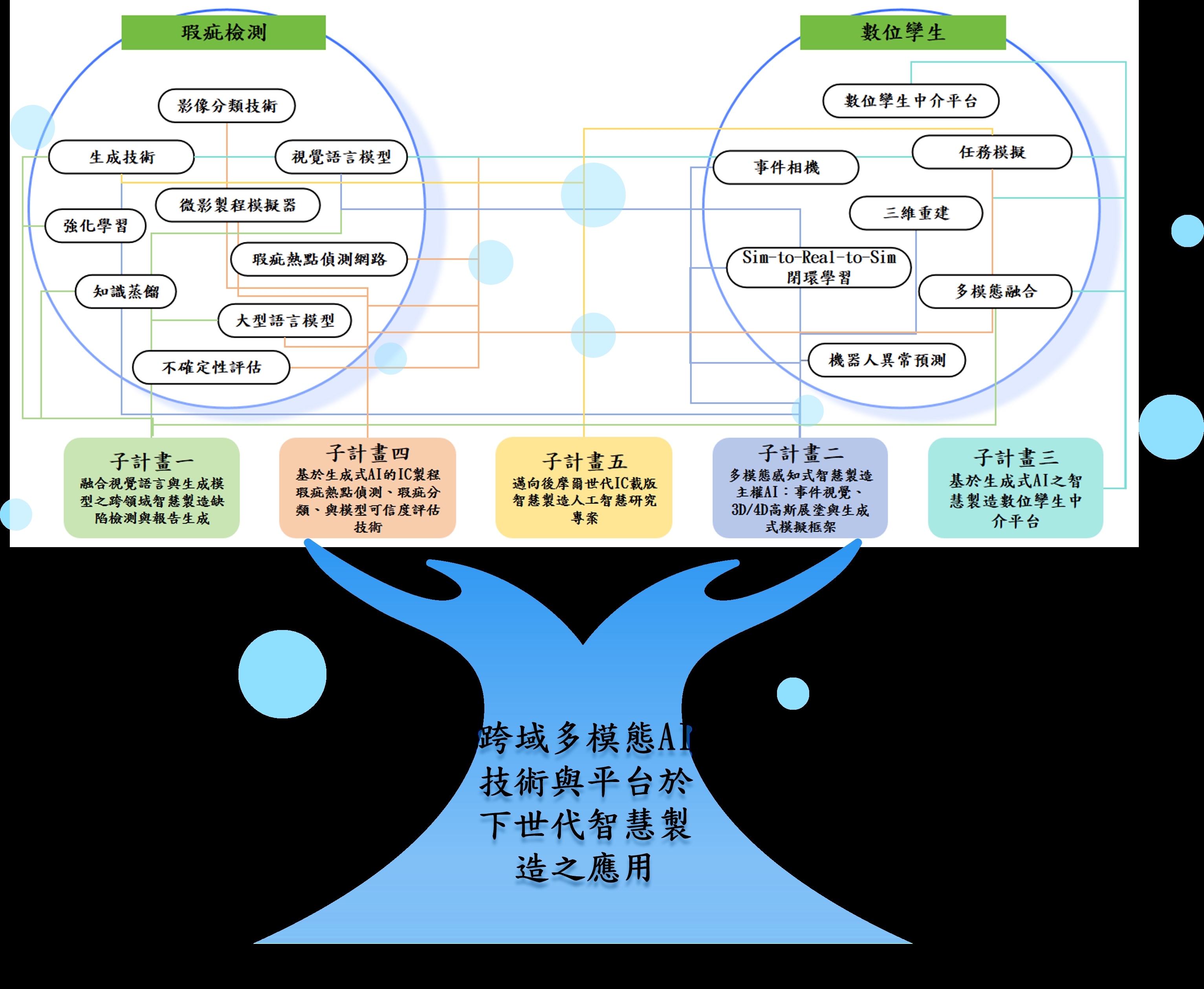
This integrated project aims to advance the application of cross-domain multi-modal artificial intelligence (AI) technologies in smart manufacturing. Focusing on key capabilities such as generative model, semantic understanding, digital twin simulation, anomaly prediction, and trustworthy decision-making, the project seeks to develop a highly integrated and modular AI-driven manufacturing system. The project consists of five tightly coupled sub-projects, covering defect image generation and diagnosis, event-based visual anomaly prediction, digital twin platform construction, IC manufacturing anomaly detection with trustworthy reasoning, and explainable AI–driven intelligent scheduling. By integrating state-of-the-art technologies—including vision-language models, multi-modal generative models, event cameras, 3D/4D Gaussian Splatting, diffusion models, graph neural networks, and reinforcement learning—the proposed system enables data sharing and modular collaboration, significantly enhancing system robustness and practical deploy-ability. From a societal and environmental perspective, the project is expected to substantially improve defect detection accuracy and early anomaly warning capabilities in manufacturing lines, thereby reducing defect rates, yield fluctuations, and material and energy waste. These advances directly support green manufacturing and sustainable development. Through close collaboration with semiconductor and advanced electronics manufacturers, the project will conduct multi-site real-world validation, strengthen industry–academia partnerships, and cultivate professional talents with expertise in AI research, manufacturing process optimization, and cross-modal system integration, thereby enhancing the competitiveness of the domestic workforce. From an economic perspective, the project will develop multiple critical AI modules to improve production efficiency, yield stability, and flexible scheduling capabilities in the semiconductor and electronics industries, while reducing reliance on manual operations. In collaboration with industrial partners, the project will accelerate the industrialization of AI technologies for process monitoring, risk assessment, and intelligent scheduling, promoting supply-chain-level innovation and strengthening international competitiveness. In addition, the project proposes a novel Sim-to-Real-to-Sim closed-loop framework centered on event-based vision and digital twin technologies to address key challenges of data scarcity, confidentiality, and high acquisition costs in manufacturing environments. By leveraging high-quality multi-modal data generation and advanced generative models, the framework enhances factory-level perception accuracy and anomaly prediction while reducing dependence on real-world data and model update costs. The integration of large language models for multi-task reasoning and explanation further improves human–AI trust and decision transparency. Overall, this project aims to drive a comprehensive upgrade of Taiwan’s smart manufacturing industry, enhancing technological autonomy and global competitiveness in high-tech manufacturing.