
Project Name
Developing Intelligent Health Agents to Drive a Paradigm Shift in Healthcare
Project Goal
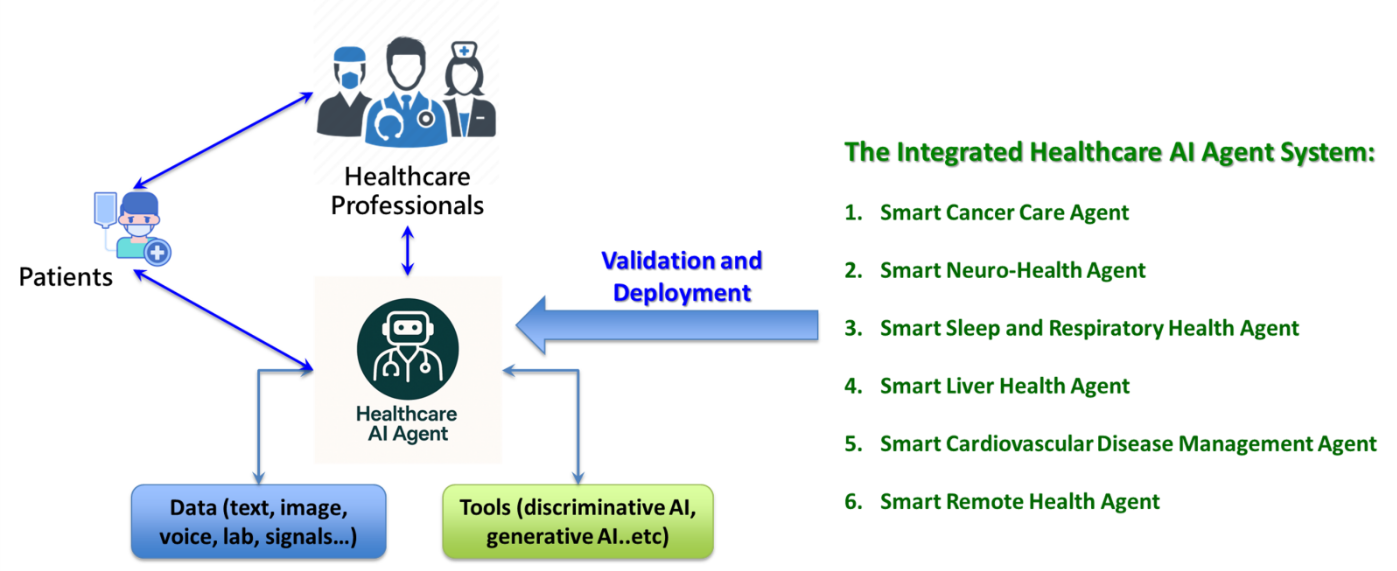
This project aims to develop an integrated smart health agent platform to address the growing challenges posed by population aging, multimorbidity, and shortages in the healthcare workforce. By shifting from reactive, hospital-centered care toward proactive prediction and personalized intervention, the platform supports a new model of continuous, intelligent health management. The project consists of six subprojects, each developing a specialized AI health agent for a major disease domain: cancer care, mental and neurological health, sleep and respiratory conditions, liver health, cardiovascular disease management, and remote/home health monitoring. These agents operate on a unified foundation that integrates multimodal data, including electronic medical records, medical imaging, physiological signals, speech features, and wearable sensor data. Through standardized data pipelines and shared representational frameworks, the agents collectively support cross-disease analysis and cross-setting clinical decision making. A cloud-based, modular architecture underpins the platform, enabling consistent workflows for model onboarding, validation, deployment, and continuous optimization. The system is designed for interoperability, scalability, and long-term maintainability, allowing independently developed modules to operate cohesively through shared APIs, common data schemas, and unified security controls. Ensuring trustworthiness and compliance, the platform integrates strong AI governance mechanisms, such as dynamic consent, differential privacy, data-protection workflows aligned with national regulations, and full-cycle trustworthy AI evaluations. The project further strengthens transparency and scientific reuse through structured mechanisms for shared model management, dataset cataloging, and reproducibility support. Through international collaboration and multi-site clinical field validation, the project demonstrates technological autonomy, global relevance, and readiness for real-world deployment. Ultimately, it contributes to building a human-centric, trustworthy, and scalable smart health ecosystem, accelerating Taiwan’s transition toward next-generation healthcare with proactive, personalized, and data-driven health services.
Project Description
This project centers on developing an integrated intelligent health agent platform to drive a paradigm shift in healthcare—from reactive, institution-centered treatment toward proactive prediction, precision intervention, and continuous, human-centered health management. In alignment with national priorities in AI development, the project establishes an autonomous, trustworthy, and adaptive AI ecosystem capable of addressing major societal challenges, including population aging, multimorbidity, workforce shortages, and disparities in healthcare resource access. For core objectives and system vision, the project develops six smart health agents, each targeting a key disease or care domain: cancer care, mental and neurological health, cardiovascular disease, liver health, sleep and respiratory disorders, and telehealth monitoring and multimodal sensing. Collectively, these agents form a cross-disease, cross-setting decision-support network, integrating multimodal data such as electronic medical records, medical imaging, speech, physiological signals, laboratory results, wearable data, and behavioral information. The unified architecture allows each agent to support domain-specific tasks while contributing to broader multimorbidity and population-health insights. For technology foundations, the platform adopts a cloud-native, modular, multi-agent architecture, enabling model onboarding, validation, deployment, and continuous updates. Core algorithms and models are developed in-house to ensure technological sovereignty, flexibility, and long-term sustainability. Unified data standards enable interoperability across care settings and allow multimodal information to be efficiently combined for risk prediction and personalized guidance. Agents perform real-time sensing, infer patient conditions using multimodal modeling techniques, predict health trajectories, and propose individualized interventions. They collaborate through shared representations and cross-agent communication mechanisms, enabling coordinated care across diseases and environments. Regarding AI governance and data security, a comprehensive, robust AI governance framework ensures safety, transparency, and regulatory compatibility. Key components include: trustworthy AI assessment throughout model development and deployment stages, dynamic consent to align with patient rights and evolving health-data policies, differential privacy, federated learning, and secure data pipelines, explainable AI techniques to enhance and support clinical interpretability, and traceability mechanisms to monitor system behavior and prevent misuse. These safeguards ensure each health agent remain auditable, predictable, and safe for use both in clinical and home care environments. We expect these agents are not only able to analyze but also to generate context-aware health recommendations. Each agent supports a full “sense → infer → predict → act → learn” cycle, incorporating feedback from clinical practice and real-world patient use. This closed-loop capability enables adaptive decision-making tailored to individual status, clinical guidelines, and environmental constraints. In addition, human-AI collaboration is emphasized: clinicians receive transparent explanations and adjustable decision thresholds, while patients access supportive conversational interfaces that enhance engagement, adherence, and self-management. The platform is designed for deployment across hospitals, long-term care facilities, community clinics, rural regions, and home settings, advancing Taiwan’s vision for continuous, integrated, and localized health management. By combining multimodal sensing, sovereign algorithm development, strong governance, and next-generation agentic intelligence, the project our project expect to create a trustworthy, secure, scalable, and human-centric smart health ecosystem. This initiative strengthens Taiwan’s leadership in smart healthcare innovation and provides a blueprint for aging societies worldwide.