
Project Name
Development of Lightweight Intelligent Agents with Local Adaptation and Sustainability: An Integrated Framework from Multimodal Language Models to Edge Deployment
Project Goal
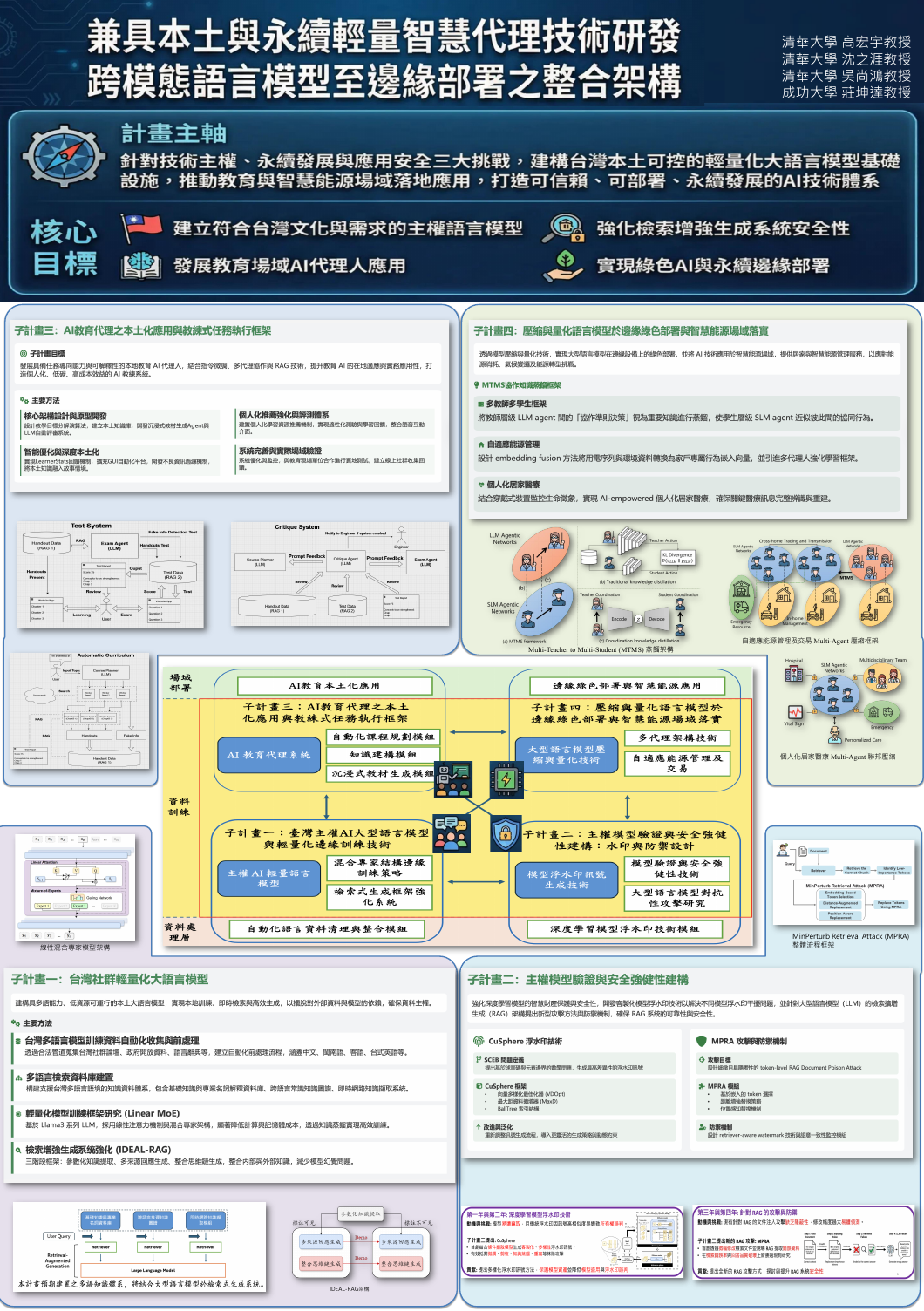
This project proposes an integrated solution to address the following three major challenges: • 1. Threats to Technological Sovereignty and the Necessity of Establishing an Autonomous Core: Historically, our country’s AI development has been highly dependent on models and platforms built by foreign tech giants. This dependence not only restricts our technical development but also poses profound risks regarding data governance and cultural adaptation. • 2. Pressures of Sustainable Development and the Demand for Green AI: The training and inference processes of large-scale AI models require massive computing power, and the resulting energy consumption has become a global emerging environmental issue. This is primarily due to the vast number of parameters inherent in Large Language Models (LLMs). • 3. Security Challenges of Forward-Looking Applications and the Construction of Trustworthy AI: As AI moves from the cloud to edge devices, new architectures—exemplified by Retrieval-Augmented Generation (RAG) and AI Agents—are being rapidly introduced into fields highly relevant to public life, such as education and healthcare. However, the security risks associated with their application are increasingly coming to the forefront.
Project Description
This project focuses on building a controllable, lightweight Large Language Model (LLM) infrastructure native to Taiwan. It aims to promote practical applications in education and smart energy, creating a trustworthy, deployable, and sustainable AI ecosystem. The project consists of four sub-projects addressing four key pillars: AI Autonomy, Robustness, Security, and Green Energy. • Sub-project 1: Taiwan Community Lightweight LLM Focuses on building a native LLM with multilingual capabilities and low-resource operational efficiency. It combines Mixture of Experts (MoE) and linear attention mechanisms to achieve local training, real-time retrieval, and high-efficiency generation. • Sub-project 2: Sovereign Model Verification & Security Robustness Concentrates on protecting model Intellectual Property (IP) and the adversarial security of RAG (Retrieval-Augmented Generation) systems. It introduces CuSphere, a next-generation watermarking technology, and fine-grained defense mechanisms against semantic search attacks. • Sub-project 3: Native AI Education Agents & Coaching Frameworks Develops explainable, task-oriented local AI education agents. By integrating instruction fine-tuning, multi-agent collaboration, and RAG technology, this project enhances the local adaptation and practical utility of AI in educational settings. • Sub-project 4: Model Compression & Green Deployment in Smart Energy Focuses on model compression, quantization, and edge deployment. Utilizing SVD (Singular Value Decomposition) and Knowledge Distillation, it facilitates AI deployment in low-power environments to realize "Green AI" and sustainable applications. Through the close collaboration of these four sub-projects, this initiative extends from core model R&D to security mechanisms and field applications. This creates a complete AI technology chain, strengthening Taiwan’s autonomy and competitiveness in the era of Sovereign AI and smart applications.