
Project Name
Next-Generation AI Agents for Socio-Agentic Collaboration
Project Goal
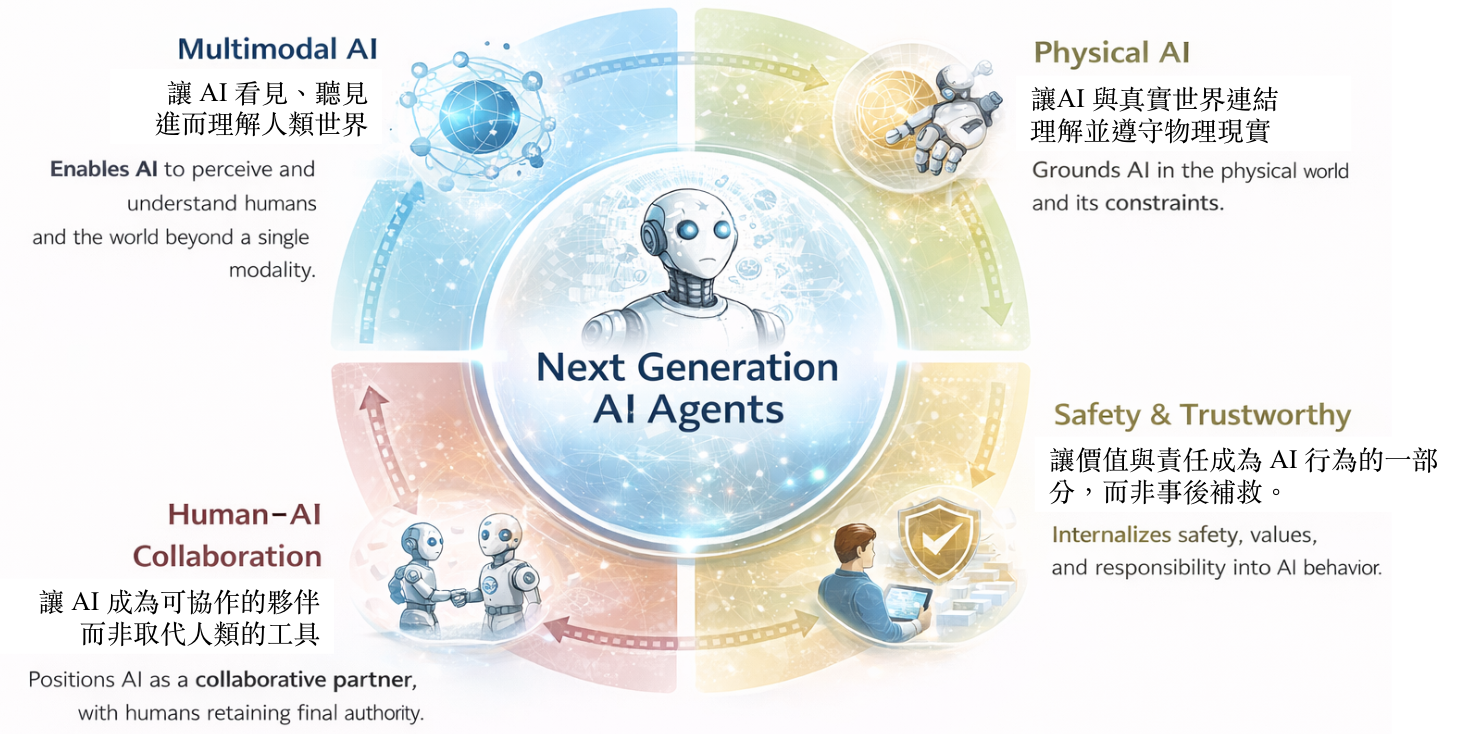
This project takes “Next-Generation Human–AI Collaborative Intelligent Agents” as its core objective, aiming to develop intelligent agent systems endowed with cross-modal understanding, autonomous reasoning, action planning, and dynamic adaptation capabilities. It seeks to advance artificial intelligence from task-oriented models toward agentic AI that is capable of long-term operation, generalization, and collaboration. By integrating key technologies—including multimodal perception, self-reflection, lightweight reasoning, human-centered interaction design, and physical intelligence—this project will establish a generalizable and trustworthy intelligent agent architecture. Such agents will be able to operate in complex and open real-world environments, engaging in natural and safe collaboration with humans, other AI systems, and embodied physical systems. The project will adopt smart industrial and commercial environments as well as smart home scenarios as validation settings, jointly addressing real-time performance, efficiency, safety, and societal acceptance, thereby realizing practical deployments that embody human–AI symbiosis. At the same time, this project emphasizes sustainability, safety, and human-centered AI principles, with the goal of strengthening Taiwan’s international competitiveness in next-generation artificial intelligence and human–AI collaboration, while fostering industrial innovation and societal well-being.
Project Description
As artificial intelligence continues to evolve from single-task models toward Agentic AI endowed with reasoning, planning, and action capabilities, enabling intelligent systems to operate reliably over long periods in real-world environments, adapt to diverse contexts, and establish trustworthy collaboration with humans has emerged as a critical research challenge. This integrated project, “Next-Generation Human–AI Collaborative Intelligent Agents: Toward a Human–AI Symbiotic Society,” directly addresses this challenge by aiming to develop a general-purpose intelligent agent architecture with capabilities in cross-modal understanding, autonomous decision-making, self-reflection, and embodied action. The project integrates five forward-looking sub-projects, encompassing efficient multimodal perception, self-reflection and anomaly detection, human-centered robot learning, lightweight and interpretable multimodal reasoning models, human–AI collaborative interaction design, and physical AI technologies grounded in 4D representations. Together, these efforts systematically address key issues of efficiency, safety, generalization, and social interaction. The research will be validated in two primary application domains—smart industrial and commercial environments and smart home settings—demonstrating the feasibility and value of human–AI collaboration in both professional and everyday life scenarios. Beyond advancing cutting-edge technologies, this project places strong emphasis on sustainability, safety, trustworthiness, and human-centered AI principles. Through cross-university, interdisciplinary, and industry–academia collaboration, the project seeks to cultivate a research team with strong international competitiveness, accelerate the real-world deployment of key technologies, and establish a solid long-term foundation for Taiwan’s leadership in next-generation artificial intelligence and human–AI symbiotic societies.