
Project Name
The Study on Enhancing the Creativity of Large Language Models through Reflective Learning and Hallucination Analysis
Project Goal
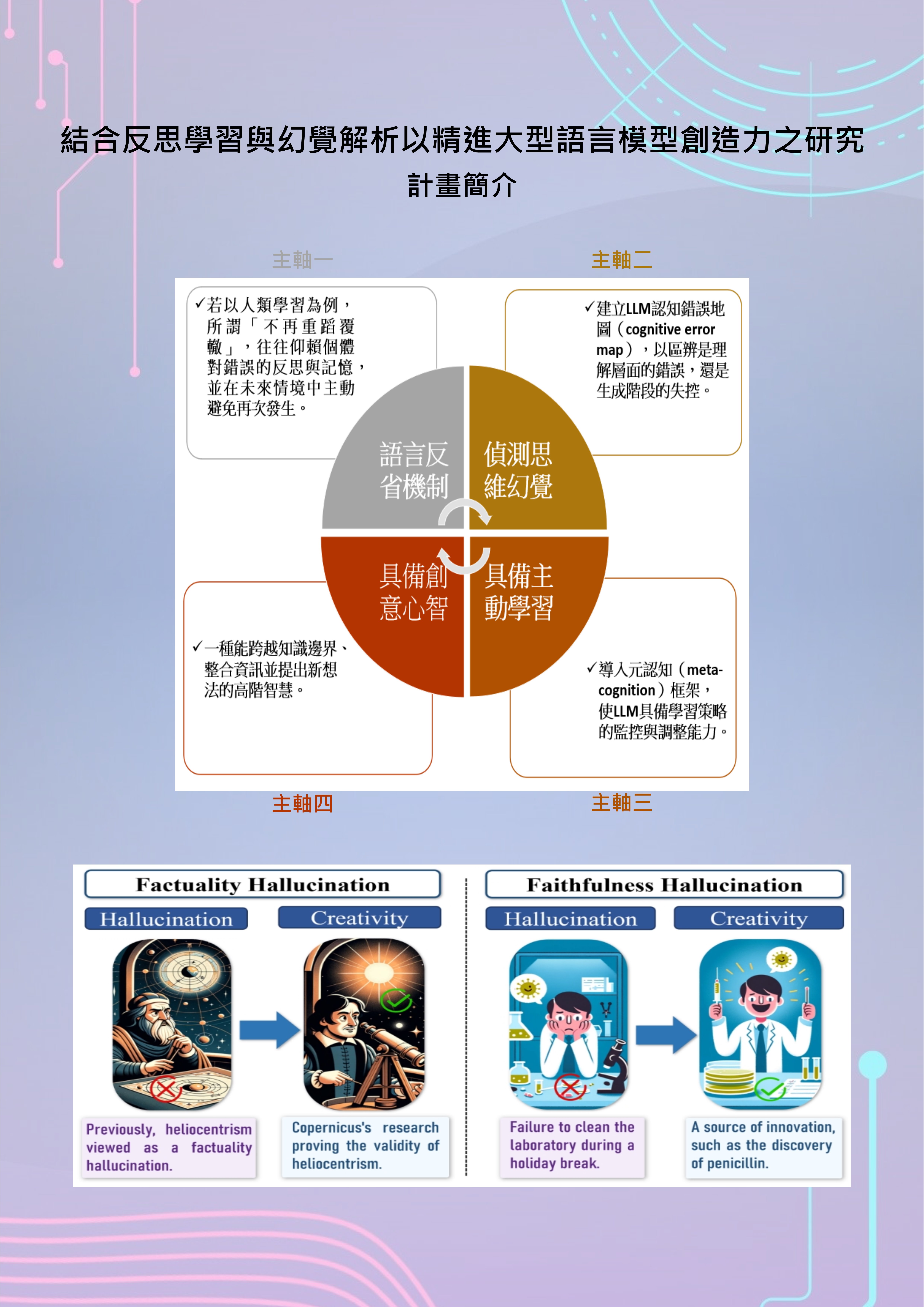
This project aims to address the two major bottlenecks of "insufficient credibility" and " lack of interpretability" encountered when applying Large Language Models (LLMs) in the medical field. The objective is to build an autonomous self-correcting agent system equipped with Meta-cognition. By introducing innovative "Reflective Learning" and "Decision Supervision" mechanisms, the system will be empowered with the capability to self-examine and correct errors. Specifically, this project will construct a "Cognitive Error Map" to precisely analyze and label hallucinations and biases within generated content and develop a foundation model agent system that possesses both fairness and reflective mechanisms. The goal is to propel AI from mere language imitation to becoming an intelligent entity with high accuracy, interpretability, and accountability, thereby realizing the objective of "Trustworthy and Self-improving" medical decision support.
Project Description
While Large Language Models (LLMs) possess significant potential, their application in professional domains such as medicine faces two major bottlenecks: "insufficient credibility" and "lack of interpretability." Due to an inability to self-examine, existing models frequently generate "hallucinations" during critical decision-making, constituting a major crisis of trust in clinical assistance. This project aims to overcome this predicament by transforming AI into a trustworthy intelligent entity equipped with "meta-cognition" and "autonomous self-correction capabilities". To fundamentally resolve these issues, this project proposes four innovative research axes. First, we will establish a "Linguistic Reflection Mechanism" to transcend the shallow corrections of Reinforcement Learning from Human Feedback (RLHF). By endowing the model with reflective memory, we enable it to learn from errors and avoid repeating them, rather than merely making superficial phrasing adjustments. Second, we will construct a "Cognitive Error Map" by combining internal representation analysis with output pattern comparison. This will precisely distinguish whether hallucinations originate from knowledge gaps, logical fractures, or generation uncontrollability, allowing for targeted intervention. Furthermore, to overcome the limitations of passive knowledge updates, we will introduce a "Meta-cognitive Framework" to create an Active Learning Language Agent. This empowers the model to proactively detect knowledge gaps and absorb new information from interactions, realizing sustainable self-evolution. Finally, viewing "Creativity" as a comprehensive indicator of high-level intelligence, we will construct an associative thinking architecture. This trains the model to perform cross-boundary knowledge integration and hypothesis deduction, positioning it as a thinking partner capable of assisting humans in scientific innovation and logical reasoning. Through the integration of these four axes, this project expects to establish an AI agent system with high accountability and accuracy, providing a safe, interpretable, and creative intelligent foundation for medical diagnosis and scientific research.