
Project Name
Toward 2030: An Interdisciplinary Taskforce for Medical Sovereignty and Digital Twin
Project Goal
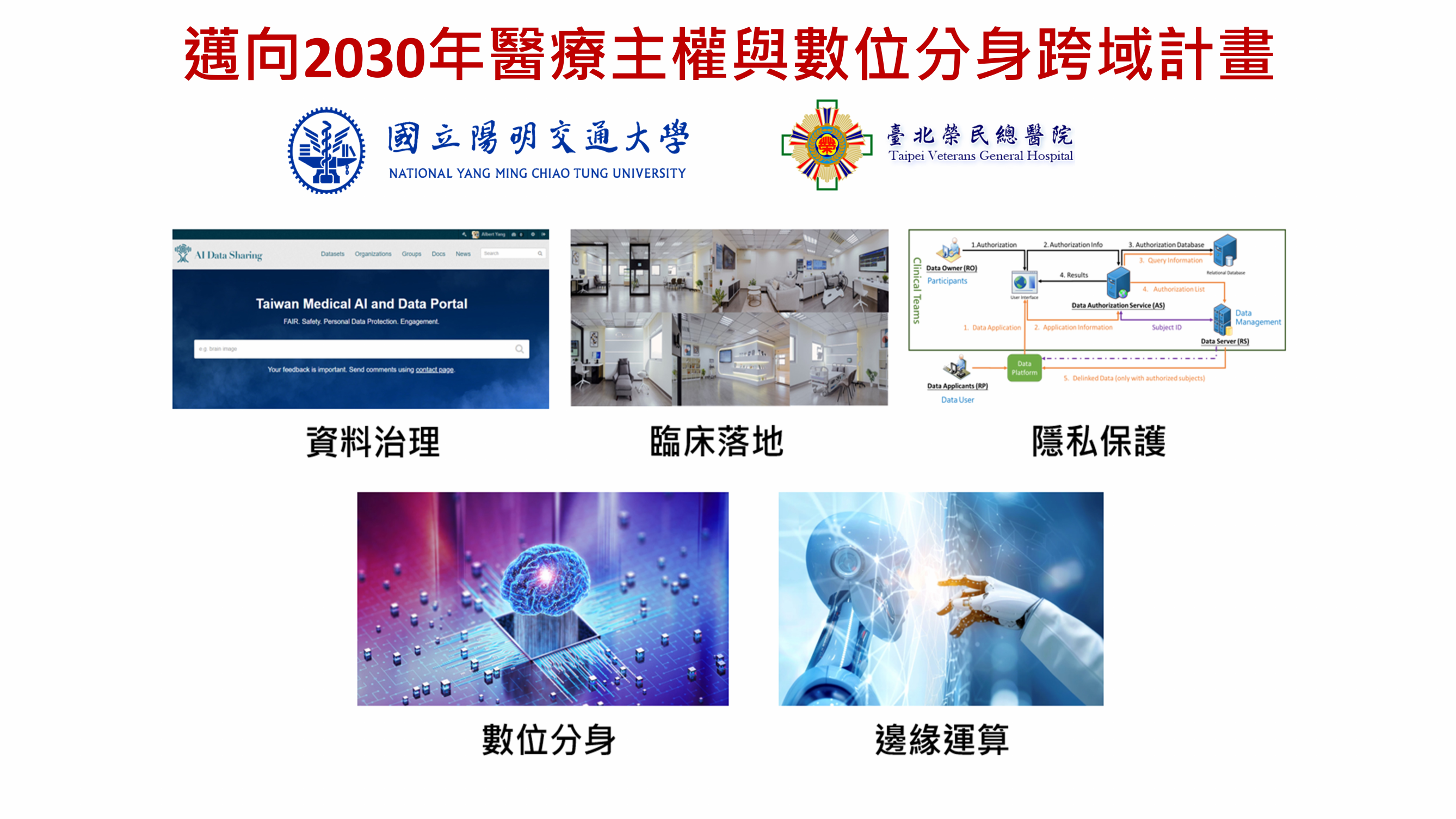
In response to the global trend in digital health and the healthcare challenges of the post-pandemic era, this project, led by National Yang Ming Chiao Tung University in partnership with Taipei Veterans General Hospital, seeks to advance cutting-edge medical technology through the dual goals of Sovereign AI and Secure AI. Traditional AI models have often relied on foreign datasets, which not only lack local relevance but also pose risks related to data leakage and algorithmic sovereignty. Building on prior achievements, this project focuses on urgent clinical needs prevalent in Taiwan, including complex neurological disorders, advanced minimally invasive surgeries, and home-based monitoring of chronic diseases. This four-year project will drive cross-disciplinary integration to provide a comprehensive solution encompassing data governance, predictive digital twin models, privacy protection, and clinical validation. By establishing a trustworthy, high-performance, and internationally impactful AI ecosystem tailored to the characteristics of the local population, we aim to address current clinical needs with innovative applications, ultimately creating a sovereign, secure, and internationally competitive paradigm for smart healthcare in Taiwan.
Project Description
This project aims to construct a cross-disciplinary smart healthcare framework centered on Medical Sovereignty and Digital Twins, with the objective of developing AI models tailored to local population characteristics and building a trustworthy AI ecosystem. Led by National Yang Ming Chiao Tung University in partnership with Taipei Veterans General Hospital, the project leverages Taiwan's most comprehensive clinical databases to enable the simulation of complex disease progression and treatment responses across diverse scenarios, including managing refractory migraine, enhancing surgical planning for gynecologic and epilepsy procedures, identifying neural biomarkers through high-resolution brain–computer interface data, and enabling chronic disease monitoring via smart wearables. To ensure secure, ethical, and legally compliant AI applications, the project will incorporate bias management and data protection impact assessments. In terms of privacy protection, we will implement technologies such as differential privacy and homomorphic encryption, while enhancing dynamic informed consent to facilitate inter-institutional collaboration. The project is expected to deliver clinically validated AI applications, including digital twin systems that simulate disease progression and surgical risk in neurological conditions, as well as smart wearable devices for real-time home health monitoring. By developing a scalable, extensible platform that embodies both Sovereign and Secure AI, we will integrate brain imaging, surgical visuals, and wearable biosignals while embedding advanced privacy-preserving and edge-computing technologies. By emphasizing modularity and open-source sharing, this platform will foster a robust domestic AI ecosystem. Ultimately, the project aims to deliver precision diagnostics and personalized therapeutic solutions tailored to the Taiwanese population, making substantial contributions to the national objective of achieving Holistic Precision Health by 2030.