
Project Name
Towards Real-World Deployment of Agentic AI Technologies
Project Goal
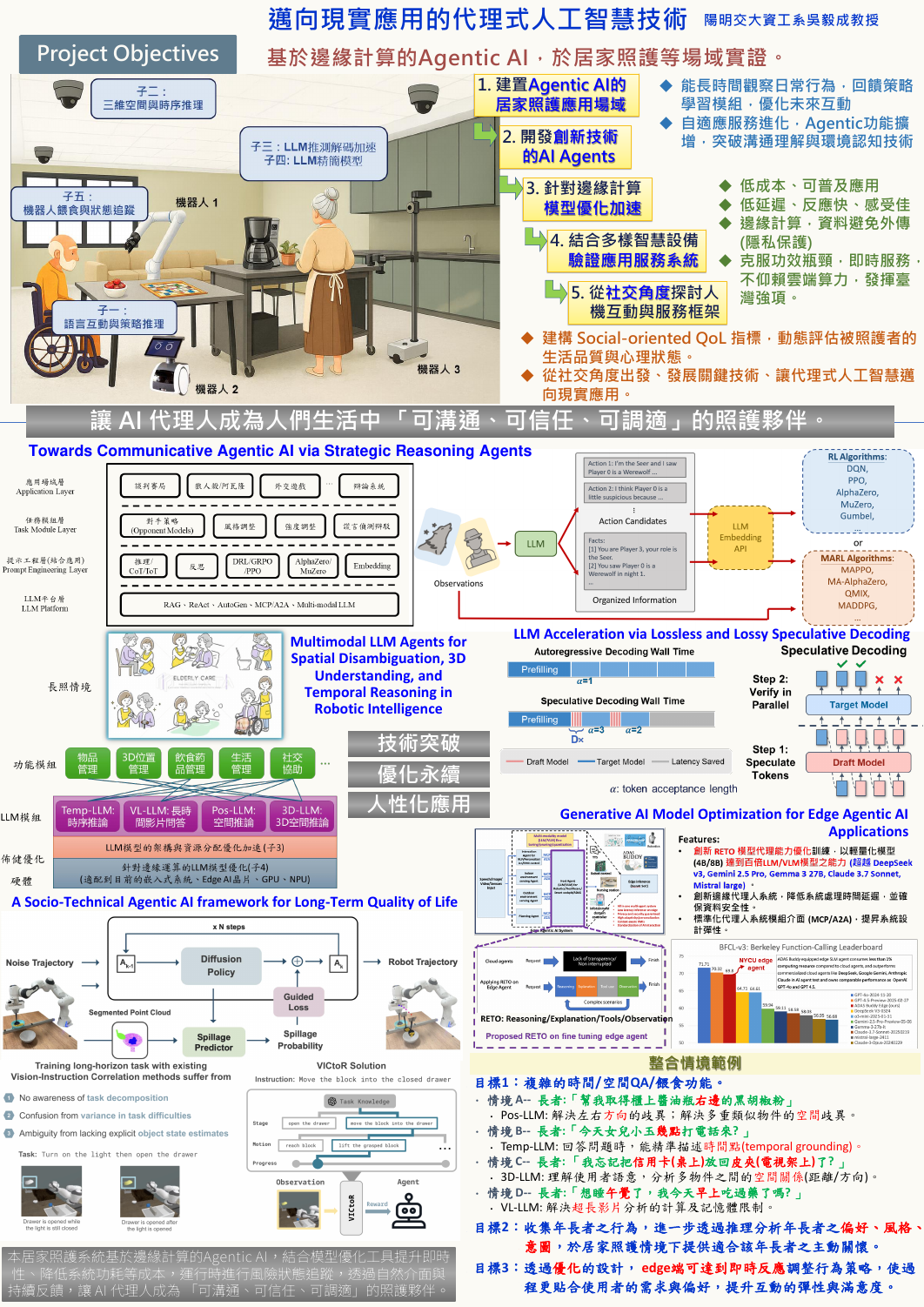
The objectives of this project include: 1) Developing AI Agents with advanced communication, reasoning and negotiation capabilities, such as multi-step reasoning, strategy planning, and role behavior simulation, to achieve natural human-machine interaction; 2) Creating multimodal LLM Agents for spatial disambiguation, 3D and ultra-long video understanding, temporal reasoning, and time-based video question answering; 3) Utilizing lossless and lossy speculative decoding to achieve LLM acceleration and memory management optimization, applying these to AI post-training processes such as reasoning and reinforcement learning; 4) Generative AI model optimization for edge systems, including model pruning, quantization, and designing optimized architectures for Agentic AI on domestic GenAI SoCs; 5) Establishing a socio-technical Agentic AI framework for long-term quality of life, exploring human-machine social interaction with multi-physical AI agents, and studying how robots can improve long-term quality of life from a social perspective, along with framework experiments. Finally, we will validate the LLM model and agent technologies developed in this project using a robotic smart home test field.
Project Description
This project will leverage Taiwan's semiconductor industry advantages to develop the latest LLM Agent technology and model optimization tools to promote Agentic AI towards reality. The objectives include: 1) Developing AI Agents with advanced communication, reasoning and negotiation capabilities, such as multi-step reasoning, strategy planning, and role behavior simulation, to achieve natural human-machine interaction; 2) Creating multimodal LLM Agents for spatial disambiguation, 3D and ultra-long video understanding, temporal reasoning, and time-based video question answering; 3) Utilizing lossless and lossy speculative decoding to achieve LLM acceleration and memory management optimization, applying these to AI post-training processes such as reasoning and reinforcement learning; 4) Generative AI model optimization for edge systems, including model pruning, quantization, and designing optimized architectures for Agentic AI on domestic GenAI SoCs; 5) Establishing a socio-technical Agentic AI framework for long-term quality of life, exploring human-machine social interaction with multi-physical AI agents, and studying how robots can improve long-term quality of life from a social perspective, along with framework experiments. Finally, we will validate the LLM model and agent technologies developed in this project using a robotic smart home test field. Optimized by tools innovated in this project, these agents will be deployed on heterogeneous robots to test advancements in environmental cognition, task understanding, agent communication, reasoning, debate consensus, collaboration, and other features of autonomous, adaptive, self-planning, and collaborative Agentic AI applications in multi-physical agent environments.